
Be the nanny every family trusts completely
The manual that shows you what to do and what to say in every situation with the child, from birth to age 12: tantrums, food, potty training, sleep and limits. With ready-to-use phrases and a form for your first conversation with the parents
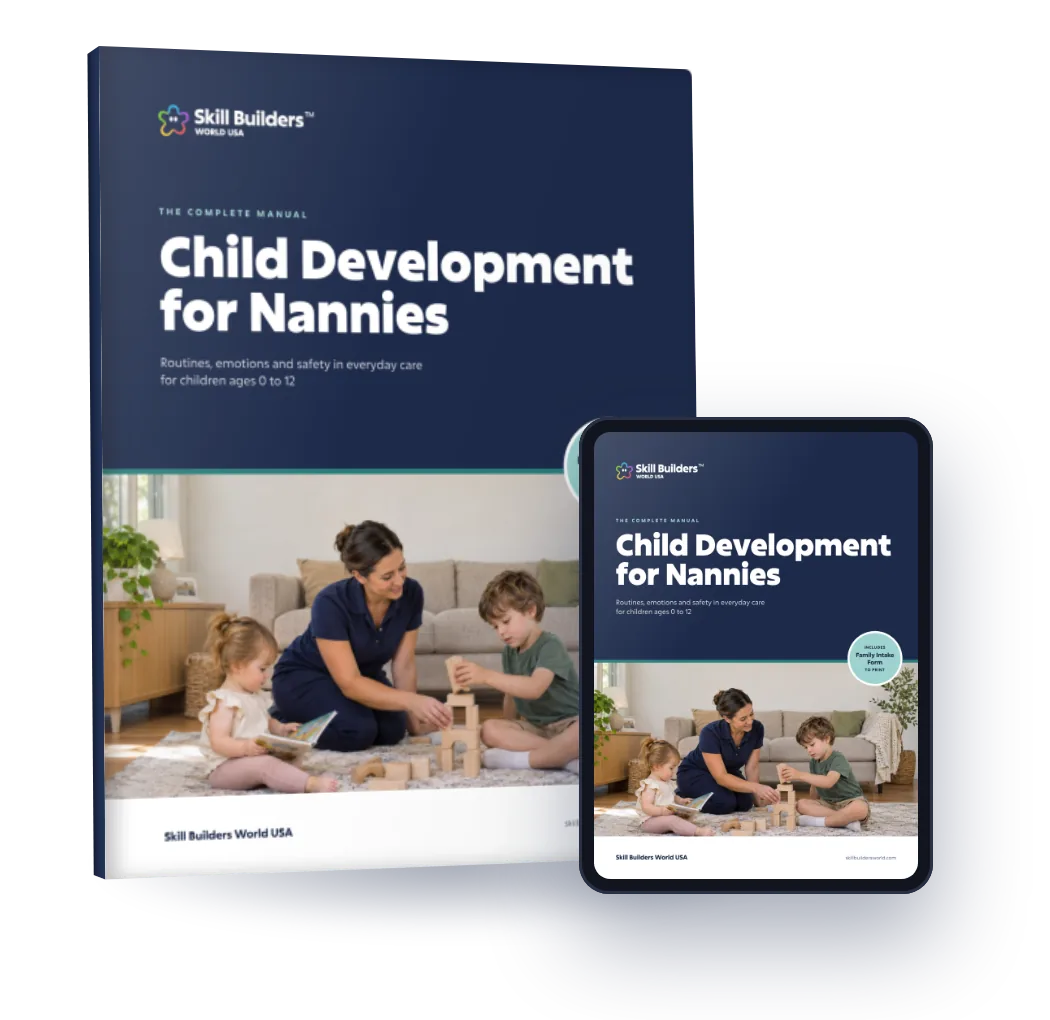
Complete Manual + Family Intake Form · Instant access
The complete manual for nannies who want to care with more safety, confidence and knowledge
- Child development from birth to age 12
- Attachment, emotions and respectful limits
- Feeding, sleep and potty training
- Play that supports development
- Safety, prevention and emergency guidance
- Inclusion and individual care
- Daily routine and how to organize your work

The child throws herself on the ground because playground time is over.
Her mom is at the door, watching.
And you have two seconds to decide: pick her up? Wait? Be firm? Ignore it?
A lot of people would settle it with a scolding. Most families here expect something else. No threats, no yelling, no “if you don’t stop right now…”. And almost no one tells you what to do instead.
So you improvise. Sometimes it works. Sometimes you can tell from the parents’ faces that it didn’t.
If this has happened to you, you’re not alone
“MB called me out and I can’t stop thinking about it.”
“I think I’m also more sensitive to tantrums/crying/etc. since both my bosses WFH and can hear everything.”
“What is gentle parenting and why is EVERY family I talk to subscribers of it? One even told me they don’t use the word no.”
“What do you guys do in these moments? When there is no time to negotiate or regulate?”
“In the interview I wasn’t told screen time rules so I had to text MB. She didn’t respond for a while.”
“I’ve not done solo potty training before so I’m struggling a bit with ideas and how to help her not feel so stressed by it.”
Excerpts from public posts by nannies on Reddit. Names left out to protect the people who wrote them. MB = mom boss.
Families don’t trust the nanny who never makes mistakes
They trust the nanny who knows what she’s doing.
- Stays calm when the child loses it.
- Follows the house routine without being reminded.
- Respects the parents’ way, even when it’s different from hers.
- Knows what a 10-month-old and a 4-year-old can and can’t do.
- Reports on the day with facts, no drama and nothing hidden.
That doesn’t come from years of experience. It comes from knowing what to do before the moment happens. That’s what the Complete Manual gives you.
The Complete Manual: Child Development for Nannies
A practical manual, in English, written for people who care for children in someone else’s home.
19 chapters that cover the whole day, from babies to school-age kids. Each chapter explains what is going on with the child at that stage and shows, in a real-life situation, what to do, what to say, word for word, and what to avoid.
No loose theory. No jargon. You read a chapter in 10 minutes and use it the same day.
6 parts, from day one to a full shift
1The role and the bond
- The nanny’s role: caring for the child within the family’s routine
- Bonding, trust and emotional security
2Every age, its own kind of care
- Babies from birth to twelve months
- Ages one to three: exploration and first limits
- Ages three to five: imagination, language and getting along
- School-age children: responsibility and self-esteem
3Emotions and limits
- Crying, tantrums and self-regulation
- Respectful limits and challenging behavior
4Potty training, feeding and sleep
- Potty training: support without pressure
- Feeding: independence, safety and respect
- Picky eating and sensory experiences
- In practice: the child who closes their mouth, who only eats rice, who only wants dessert
- Sleep and rest within the family’s habits
5Playing, talking and doing it alone
- Language, listening and shared reading
- Play that supports development
- Independence in hygiene, dressing and tidying up
6Safe and inclusive care
- Inclusion and individual differences
- Safety, prevention and emergency response
- Observing to adapt your care
- A practical day: from the start to the end of the shift
A real page from the manual
Chapter 7, “Crying, tantrums and self-regulation”. Real-life situation: the child throws themselves on the floor and screams.
What to avoid: humiliation, filming the meltdown or demanding an apology in the middle of the tears.
All 19 chapters follow this format: real-life situation, ready-to-use phrase, what to do next and what to avoid.
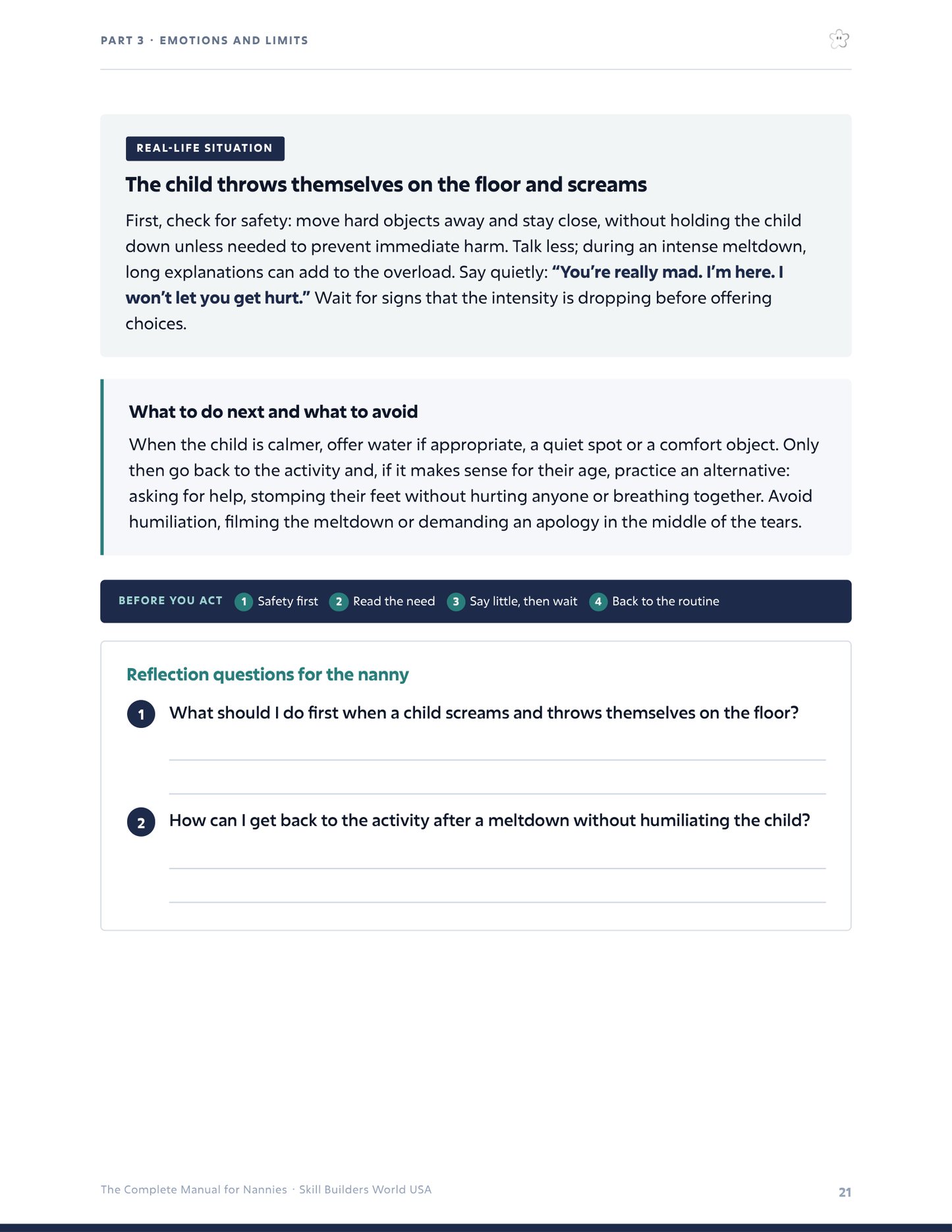
4 steps before you act
Before the chapters, the manual gives you a 4-step way of thinking to use whenever you’re unsure:
- Safety firstIs there any physical risk? Deal with that before anything else.
- Read the needDoes the child need help, rest, predictability, space or a chance to take part?
- Say little, then waitShort words that fit the child’s age. Wait for a response.
- Back to the routineWithout turning the moment into a judgment of the child.
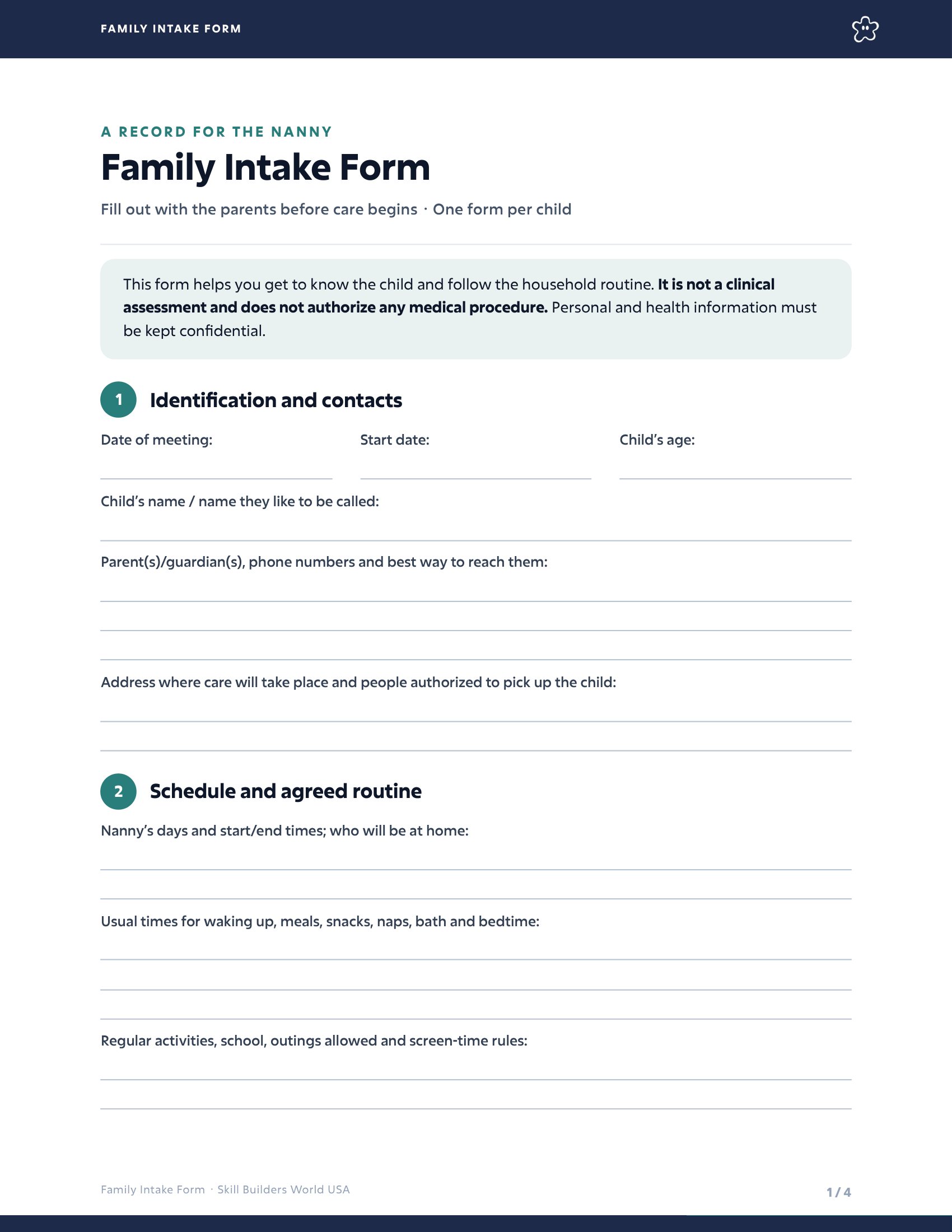
Family Intake Form
Your first conversation with the family sets the tone. Showing up with the right questions proves you’re a professional before day one.
- Routine and schedules
- What the child eats and what’s off-limits
- Allergies and emergency plan
- Sleep, hygiene and potty training
- How the child communicates and what calms them down
- What you can and can’t do, from outings to photos
Comes as a printable PDF and as an editable version for Word or Google Docs.
Made for people who care for children in the U.S., and for the families who hire them

It’s for you if:
- You’re a nanny or au pair in the U.S. and want to care with more confidence.
- You’re starting with a new family.
- You have experience, but feel that families here expect something different from what you learned.
- You want to understand what’s behind the child’s behavior, not just react to it.
- You’re a parent who wants to prepare your nanny: give her the manual to read and use the form in your first conversation.
It’s not for you if:
- You’re looking for a certification. This manual is a study and reference guide, not a certificate.
- You want first aid and CPR training. For that, take an in-person course.
The content follows research on child development: attachment theory (Bowlby), learning with adult support (Vygotsky) and the development of thinking (Piaget). The guidance on safety, sleep and feeding follows the public recommendations of the American Academy of Pediatrics (AAP), the CDC and the World Health Organization. All sources are listed at the end of the manual.
The Complete Manual: Child Development for Nannies
- The complete manual in PDF: 57 pages, 19 chapters, 6 parts
- The printable Family Intake Form
- The editable Family Intake Form (Word and Google Docs)
Secure checkout by Payhip
Instant access by email. Read it on your phone or computer, or print it.
7-day guarantee
Read the manual. If you feel it isn’t worth what you paid, ask for a refund within 7 days by replying to your purchase email, and we’ll give you 100% of your money back.
Still have questions?
I’m a parent. Can I buy it for my nanny?
Yes. It’s a way to prepare your nanny before she starts. Give her the manual to read and use the Family Intake Form in your first conversation: that’s where you agree on routine, food, sleep, house rules and what to do in an emergency.
Is the manual in English?
Yes, the whole text is in English. It also comes in Portuguese and Spanish, sold separately.
Does it work for au pairs?
Yes. The manual covers the day-to-day of caring for a child in the family’s home, which is exactly an au pair’s routine.
Do I need experience?
No. If you’re just starting, you learn the basics of each stage. If you have experience, you get the right words for situations you handle on the fly today.
Is it a certificate?
No. It’s a study and reference guide. It does not replace a certification or first aid and CPR training.
How do I get it?
Right after payment, the download appears on screen and you also get an email with the link to download the manual and the forms.
Can I read it on my phone?
Yes. The PDF opens on your phone, tablet and computer. You can also print it.
Can I use the form with several families?
Yes. Use one form per child, as many times as you need.
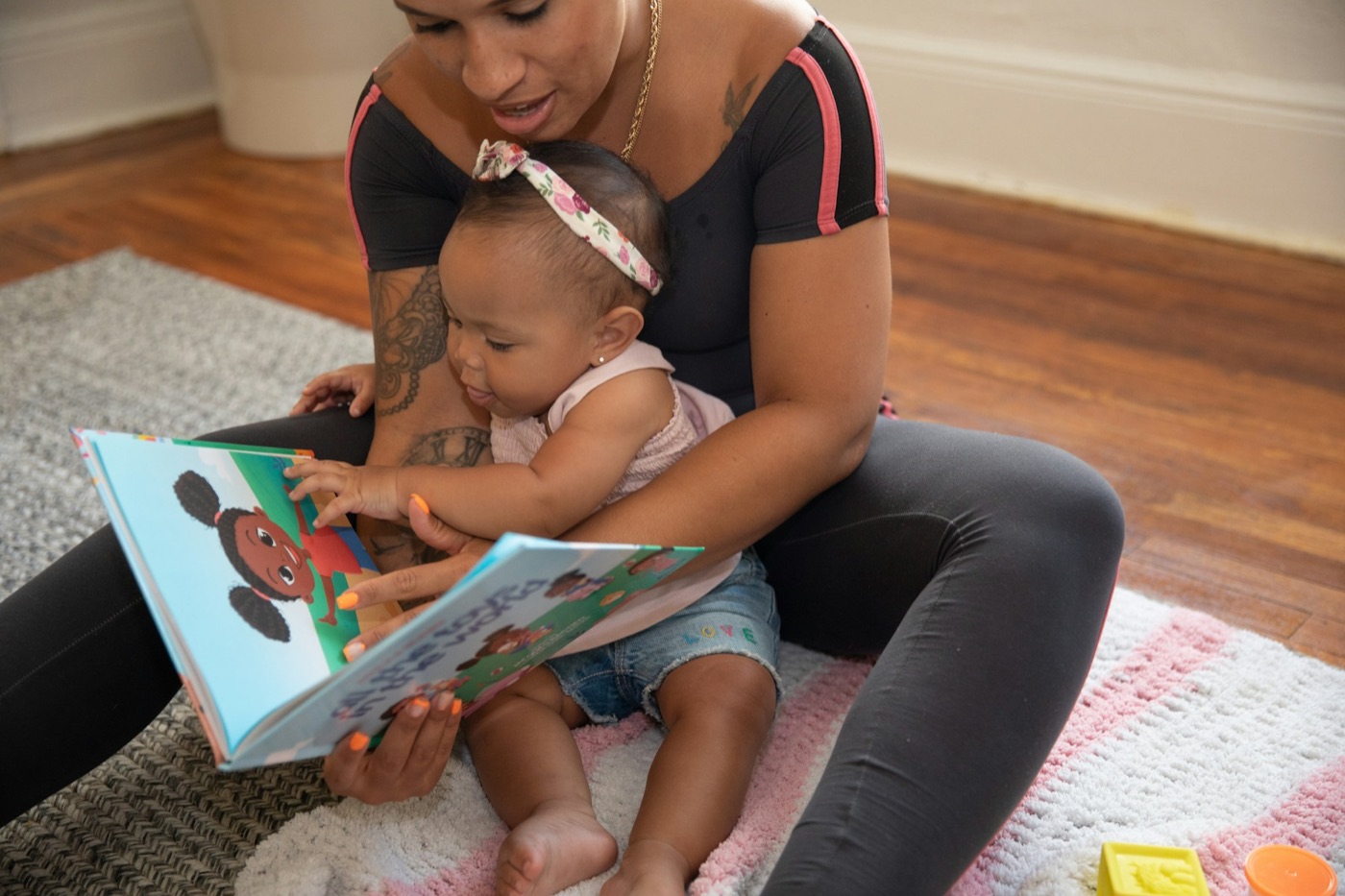
A family doesn’t need a perfect nanny. They need a nanny who knows what to do.
Be the nanny every family trusts completely
Get the Complete ManualWas $49, now $19.99 · 7-day guarantee